
Legal Intelligence
Advice on Repatriation of Profits and Investments in Bangladesh
In short
Profits, dividends and the proceeds of selling an investment can be remitted out of Bangladesh under the exchange control regime the Bangladesh Bank administers, provided the original inward investment was properly brought in through the banking channel and reported, and the tax position is clear. In practice the documentation created when money enters Bangladesh is what determines how straightforward it is to take it out later.
Bangladesh, one of South Asia’s fastest-growing economies, continues to attract substantial foreign direct investment (FDI) due to its liberal investment regime, strategic location, and competitive labour costs. A critical consideration for foreign investors is the repatriation of profits, capital, and disinvestment proceeds. This article provides a comprehensive guide to the legal procedures, regulatory framework, practical steps, and challenges associated with the Repatriation of Profits and Investments in Bangladesh.
Legal Framework for Repatriation of Profits And Investments In Bangladesh
The right to repatriate profits and investments is protected by national legislation and supported by international treaties and bilateral investment agreements.
Key Laws and Regulations for Repatriation of Profits And Investments In Bangladesh
- Foreign Private Investment (Promotion and Protection) Act, 1980
- Foreign Exchange Regulations Act, 1947
- Guidelines for Foreign Exchange Transactions (GFET)
- Income Tax Act, 2023
- Bangladesh Investment Development Authority (BIDA) Act, 2016
- One Stop Service Act, 2018
These laws collectively guarantee non-discriminatory treatment for foreign investors and allow for the repatriation of:
- Dividends and profits
- Salaries and savings of expatriates
- Sale proceeds from shares and disinvestment
- Royalties and technical fees
- Capital gains and interest on foreign loans
Eligibility and Preconditions for Repatriation of Profits And Investments In Bangladesh
To legally repatriate funds, foreign investors must fulfil several conditions:
- Investment Registration
All foreign equity investments must be registered with BIDA. - Documentary Compliance
Repatriation requests must be backed by audited financials, tax clearance certificates, and proper banking records. - Tax Clearance
All applicable taxes—including corporate tax, capital gains tax, and withholding tax—must be fully paid. - Use of Authorized Dealer (AD) Banks
Only licensed commercial banks designated as Authorized Dealers may process repatriation under supervision from Bangladesh Bank.
Categories of Repatriable Funds
1. Dividends and Profit Repatriation
Foreign shareholders may repatriate net dividends after:
- Deducting a 20% withholding tax (subject to Double Taxation Agreements)
- Submitting board resolutions, audited accounts, and evidence of dividend declaration
2. Disinvestment and Capital Repatriation
Upon sale or transfer of shares:
- A foreign investor may repatriate the sale proceeds after tax adjustment
- Valuation must be conducted by an independent chartered accountant or merchant banker
3. Royalty, Franchise, and Technical Fees
These payments are repatriable only if:
- The underlying agreement is approved by BIDA
- The total fee does not exceed 6% of the annual turnover unless otherwise justified
4. Loan Repayments and Interest
Foreign loans approved by the Bangladesh Bank can be serviced and repatriated. Approval typically covers:
- Principal repayment schedule
- Interest rate and fees
- Grace period and tenor
Step-by-Step Process for Repatriation of Profits And Investments In Bangladesh
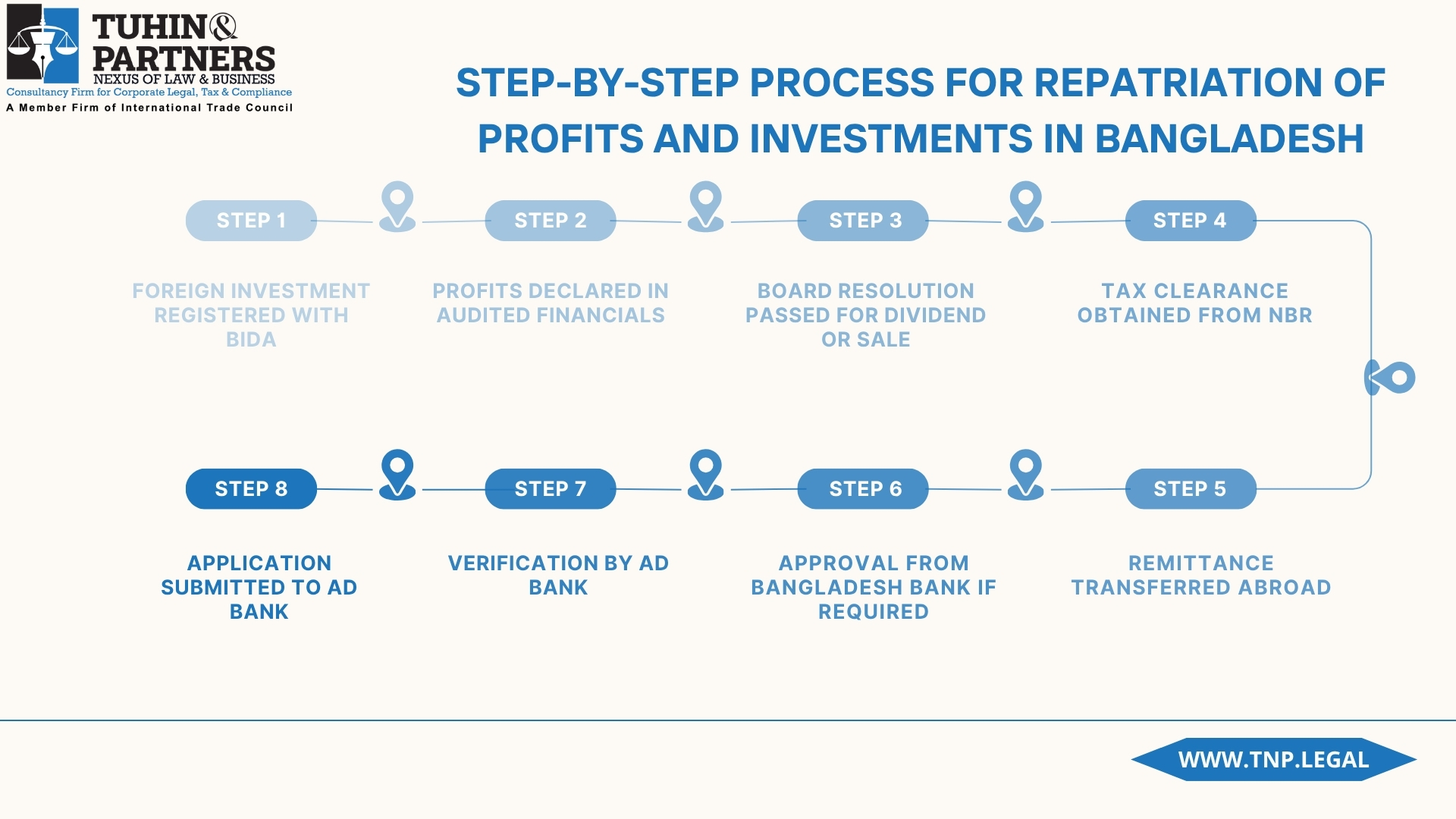
Role of Bangladesh Bank and BIDA for Repatriation of Profits And Investments In Bangladesh
Bangladesh Bank
- Monitors foreign exchange transactions
- Requires prior approval for certain high-value or sensitive remittances
- Maintains data on remittance flows and FDI
BIDA
- Registers foreign investments
- Approves technical assistance and royalty agreements
- Acts as a one-stop service centre for investor facilitation
Tax Implications of Repatriation for Profits And Investments In Bangladesh
Understanding the tax regime is critical for efficient fund repatriation:
| Type of Income | Applicable Tax | Notes |
|---|---|---|
| Dividends | 20% Withholding Tax | May be reduced under Double Taxation Avoidance Treaties |
| Capital Gains | 15% (non-resident) | Based on differential between sale and cost |
| Royalty/Tech Fees | 20% Withholding Tax | Subject to BIDA approval |
| Interest on Loans | 20% Withholding Tax | Tax treaties may provide relief |
Foreign investors are advised to consult tax professionals to leverage Double Taxation Avoidance Agreements (DTAAs) for tax optimization.
Common Challenges and Practical Tips for Repatriation of Profits And Investments In Bangladesh
Challenges
- Delays in Tax Clearance from the National Board of Revenue (NBR)
- Currency convertibility issues during macroeconomic shocks
- Regulatory ambiguity on disinvestment valuation
- Frequent changes in tax and banking circulars
Practical Tips
- Ensure early BIDA registration and approval of service agreements
- Maintain clear and auditable documentation
- Engage with reputed chartered accountants and tax advisors
- Work closely with Authorized Dealer banks with international transaction experience
Recent Developments and Reforms
- Bangladesh Bank Circular (2023) enabled the repatriation of capital gains without prior approval if within specified thresholds
- BIDA OSS Portal (One Stop Service) has streamlined approval and registration processes
- Digital tax return and clearance system implemented to reduce delays
Conclusion
Bangladesh offers an increasingly investor-friendly regime for repatriating profits and investments. However, compliance with regulatory formalities, proactive tax planning, and diligent documentation are essential. Foreign investors are strongly encouraged to engage legal, tax, and financial advisors to ensure a smooth repatriation process aligned with national laws and international standards.
Need Expert Help?
Tuhin & Partners assist foreign investors with end-to-end support—from BIDA registration and agreement structuring to tax clearance and fund repatriation. Reach out today to ensure your investments are secure and your profits are repatriated legally and efficiently.
[sp_easyaccordion id="3300"]
Common questions
Can dividends be remitted abroad from Bangladesh?
Yes, dividends on shares held by non-residents may be remitted through an authorised dealer bank, subject to tax having been paid or withheld and the supporting documentation being in order.
What is needed to remit the proceeds of a share sale?
Evidence that the original investment came in through the banking channel and was reported, a valuation supporting the sale price where required, and tax clearance. Missing inbound documentation is the most common reason an exit gets stuck.
Can a foreign loan be repaid out of Bangladesh?
Repayment of foreign borrowing requires that the borrowing itself was approved under the applicable exchange control rules before it was drawn. Approval sought only at repayment is a much harder application.
Please note. This is general information about the law as it stood on 19 May 2025, not legal advice, and no solicitor–client relationship arises from reading it. Law and practice change; take advice on your own facts before acting.