
Legal Intelligence
RJSC Return Filing in Bangladesh: A Complete Step-by-Step Guide
In short
Every company registered in Bangladesh must file returns with the Registrar of Joint Stock Companies and Firms (RJSC), including an annual return following the annual general meeting and event-based filings when directors, shareholding, registered office or capital change. Filing is a continuing obligation for the life of the company, and unfiled returns surface as an obstacle during financing, sale or any transaction requiring due diligence.
RJSC Return Filing is one of the most critical compliance obligations for companies, partnerships, and registered entities in Bangladesh. The Registrar of Joint Stock Companies and Firms (RJSC) is the authority that oversees corporate filings and ensures that all entities operate under the Companies Act 1994 and other applicable laws.
Timely RJSC Return Filing not only avoids legal penalties but also strengthens transparency, credibility, and governance within a business. This article provides a detailed overview of the RJSC Return Filing process in Bangladesh, its types, required documents, deadlines, and compliance guidelines.
What is RJSC Return Filing?
RJSC Return Filing refers to the statutory submission of reports, documents, and forms to the RJSC by companies and registered entities. These filings confirm the company’s structure, financial performance, director/shareholder information, and any changes in corporate affairs.
It ensures:
Legal compliance with corporate regulations.
Transparency for shareholders and investors.
Smooth operation of banking, investment, and contractual relationships.
Types of RJSC Return Filing in Bangladesh
Different types of returns must be filed depending on the company’s activities and changes in its corporate structure.
1. Annual RJSC Return Filing
Every company must file an Annual Return after holding its Annual General Meeting (AGM). This return discloses:
List of directors, shareholders, and secretary.
Company’s registered office address.
Shareholding structure.
Paid-up and authorized capital.
📌 Deadline: Within 21 days of the AGM.
2. Return of Share Allotment
When new shares are issued, the company must complete an RJSC Return Filing of share allotment. This filing records:
Number of shares allotted.
Updated shareholder list.
Paid-up capital after allotment.
Revised ownership ratio.
📌 Deadline: Within 60 days of allotment.
3. Return of Change of Directors/Officers
Changes in the company’s directors or managing agents must be notified through RJSC Return Filing. Information required includes:
Resignation or appointment details.
Updated particulars of directors.
Board resolution confirming the change.
📌 Deadline: Within 30 days of change.
4. Amendments to Memorandum and Articles of Association
If the company alters its Memorandum of Association (MOA) or Articles of Association (AOA), an RJSC Return Filing is mandatory. Required documents include:
Certified copy of the special resolution.
Updated MOA & AOA.
RJSC-approved amendment papers.
📌 Deadline: Within 15 days of the special resolution.
5. Winding Up and Dissolution Returns
Companies closing their operations must file RJSC Returns for dissolution, which include:
Statement of affairs.
Final audited accounts.
Liquidator’s report.
Required Documents for RJSC Return Filing
The documents required vary by filing type, but generally include:
Annual Return: Form XV, audited financial statements, directors’ report.
Share Allotment: Form IX, shareholder list, board resolution.
Director Changes: Form XII, resignation/appointment documents, board resolution.
Amendments: Updated MOA/AOA, certified resolution copy.
Dissolution: Final accounts, liquidator’s report.
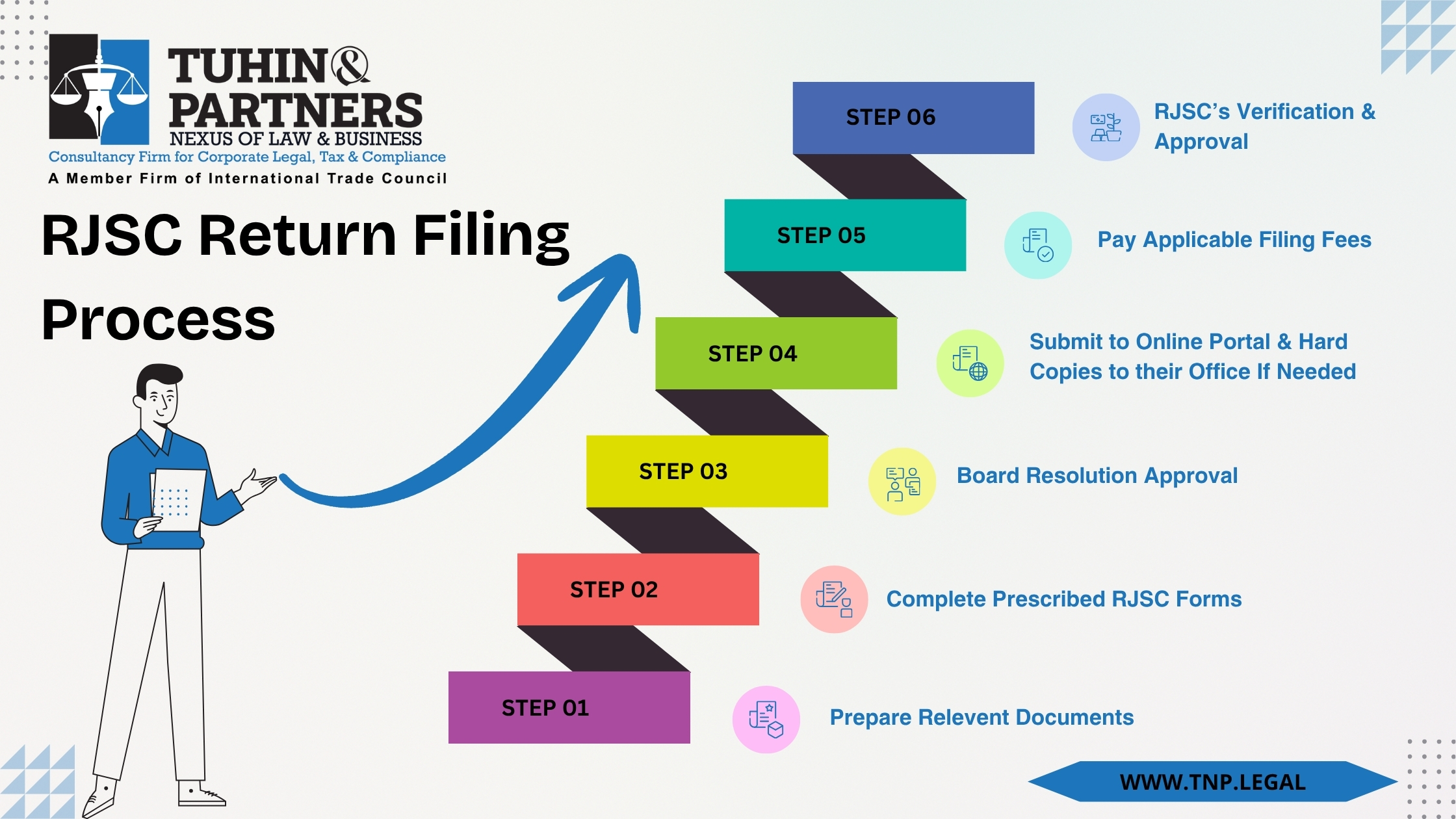
RJSC Return Filing Process
The process of RJSC Return Filing follows a clear sequence:
Penalties for Non-Compliance in RJSC Return Filing
Failing to meet deadlines for RJSC Return Filing results in:
Daily fines for directors and company officers.
Additional late filing charges.
Legal consequences, including restrictions on operations.
Importance of Timely RJSC Return Filing
Ensures compliance with the Companies Act 1994.
Protects directors from liability and penalties.
Builds investor and shareholder confidence.
Supports banking and investment transactions.
Strengthens corporate governance in Bangladesh.
Professional Assistance for RJSC Return Filing
We provide comprehensive RJSC Return Filing services to ensure your company remains fully compliant. Our services include:
Preparing and filing annual and statutory returns.
Drafting board resolutions and legal documents.
Liaison with RJSC authorities.
Advisory on restructuring, capital changes, and amendments.
Ongoing compliance monitoring.
With professional support, businesses can avoid costly penalties and maintain smooth corporate operations.
Conclusion
RJSC Return Filing in Bangladesh is a legal requirement that demands accuracy, timely submission, and compliance with prescribed formats. Whether it’s an annual return, a change in directors, a share allotment, or amendments to corporate documents, companies must ensure proper filing to protect their legal standing and credibility.
By following the correct RJSC Return Filing process, businesses safeguard their operations, maintain regulatory compliance, and build long-term trust with stakeholders.
[sp_easyaccordion id="6674"]
rnCommon questions
What returns must a Bangladeshi company file with RJSC?
An annual return following the AGM, together with filings triggered by specific events — changes of director, transfers or allotments of shares, alteration of capital, change of registered office, and amendments to the memorandum or articles.
What happens if RJSC returns are not filed?
The company and its officers become exposed to penalties, and the practical consequence is that the public record no longer matches reality — which is discovered, expensively, during due diligence on a sale or financing.
Can missed filings be brought up to date?
Overdue filings can generally be regularised, though the process is more involved than filing on time and may attract penalties. It is worth doing before a transaction rather than during one.
Please note. This is general information about the law as it stood on 17 August 2025, not legal advice, and no solicitor–client relationship arises from reading it. Law and practice change; take advice on your own facts before acting.