Export Registration Certificate, better known as the ERC, is the license that turns an intention to export into a legal reality. If you’re planning to export from Bangladesh, there’s one document that sits at the center of it all. No shortcuts. No workarounds.
Think of it as your passport into the global marketplace. Without it, banks won’t open export LCs, customs won’t clear shipments, and buyers won’t take you seriously. With it, the doors open.
Let’s walk through what the ERC is, why it matters, and how businesses in Bangladesh actually get it—step by step—without the jargon and confusion.
What Is the Export Registration Certificate (ERC)?
At its core, the Export Registration Certificate is the mandatory authorization that allows a Bangladeshi business to export goods or services legally. It’s issued by the Office of the Chief Controller of Imports & Exports (CCI&E) under the Ministry of Commerce.
The entire application and licensing process runs through the Online Licensing Module (OLM) portal operated by CCI&E. That means no manual files, no paper challans, and no in-person submissions for the core process.
The ERC isn’t optional. Before a single shipment leaves the country—or a service invoice is settled through banking channels—this certificate must be in place.
The Legal Backbone Behind the Export Registration Certificate (ERC)
The requirement for an ERC doesn’t come out of nowhere. It’s grounded in Bangladesh’s trade control framework.
The legal authority for ERC registration flows from the Imports and Exports (Control) Act, 1950. That framework is implemented through regulatory instruments such as the Importers, Exporters and Indentors (Registration) Order, 1981.
In practical terms, this means the ERC is not just a procedural formality. It’s a compliance requirement embedded in national law and enforced by banks, customs authorities, and regulators across the export chain.
Why the Export Registration Certificate Matters
So why does the ERC carry so much weight?
1. Legal Right to Export
The ERC gives your business the legal authorization to export from Bangladesh. Without it, export transactions simply can’t move forward through the banking and customs systems.
2. Banking and Customs Access
Banks rely on the ERC to process export documentation, including opening letters of credit. Customs authorities reference it during clearance. It’s a foundational document in both systems.
3. Recognition as a Registered Exporter
Holding an ERC signals that your business is formally recognized by the government as an exporter. That recognition matters when dealing with buyers, financial institutions, and regulatory bodies.
4. Digital, Centralized Verification
With the OLM system, verification is centralized and transparent. Once approved, your ERC is available digitally, reducing delays and administrative friction.
Who Needs an Export Registration Certificate?
The scope is broad. Any entity intending to export from Bangladesh typically needs an ERC, including:
-
Private Limited Companies
-
Partnership Firms
-
Proprietorships
-
NGOs and Associations (where applicable)
-
Export-oriented manufacturers
-
Service exporters, when required by banks or contracts
If you plan to receive export proceeds through formal banking channels, the ERC is not negotiable.
Issuing Authority: Where the Export Registration Certificate (ERC) Comes From
All ERCs are issued by the Office of the Chief Controller of Imports & Exports (CCI&E).
Head Office Details:
-
Address: NSC Tower (National Sports Council Building), 62/3, Purana Paltan, Dhaka-1000
-
Phone: +88-02-9553349
-
Fax: +88-02-9550217
-
Email: controller.chief@ccie.gov.bd
-
Website: ccie.gov.bd
While the authority is based in Dhaka, the application itself is handled online through the OLM portal.
How to Obtain the Export Registration Certificate: Step by Step
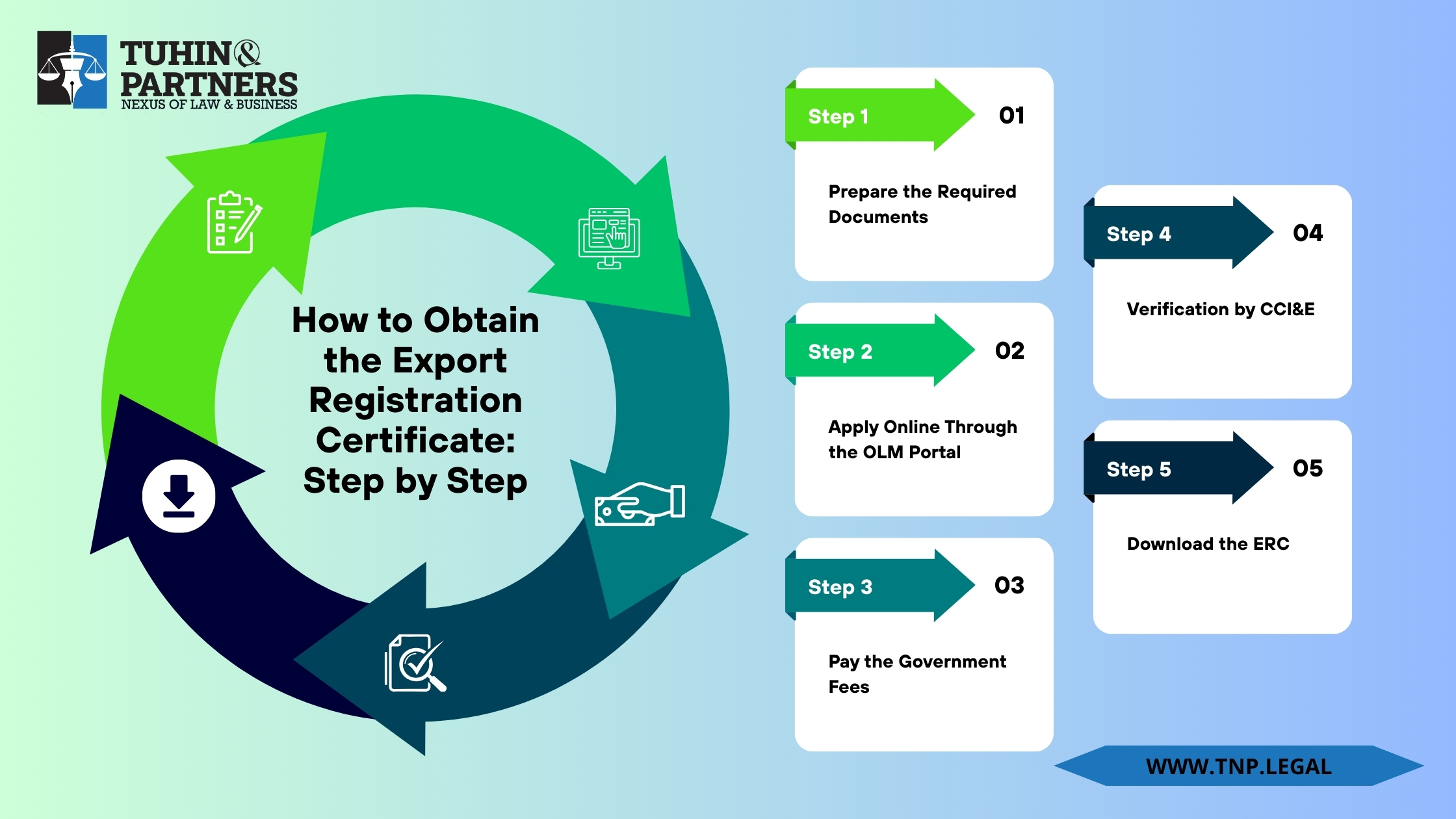
The ERC process follows a clear sequence. When documents are complete and accurate, it moves quickly.
Step 1: Prepare the Required Documents
Before logging into OLM, gather and scan your documents in color. Typically required documents include:
-
Valid Trade License
-
e-TIN Certificate
-
VAT/BIN Registration
-
Bank Solvency Certificate from a scheduled bank
-
Certificate of Incorporation (for companies)
-
Memorandum and Articles of Association (companies)
-
Partnership Deed (for partnerships)
-
National ID or Passport of proprietor, partners, or directors
-
Passport-size photographs of owners or directors
-
Membership Certificate from a recognized Chamber or Trade Association (commonly required)
Practical tip: Ensure the business name and address are exactly the same across all documents, especially the Trade License. Inconsistencies are one of the most common reasons for queries.
Step 2: Apply Online Through the OLM Portal
The application is submitted entirely online.
You’ll need to:
-
Register or log in to the CCI&E OLM account
-
Select “Export Registration Certificate.”
-
Complete the application form
-
Upload the scanned documents
-
Submit the application
Manual bank challans are no longer accepted. Everything flows through the digital system.
Step 3: Pay the Government Fees
Once the application is ready, fees are paid online through OLM-supported payment channels, including bank transfers, EFT, or mobile banking.
Current commonly referenced fee benchmarks are:
-
Initial ERC Registration: BDT 10,000 + 15% VAT (BDT 11,500 total)
-
Annual Renewal: BDT 7,000 + 15% VAT (BDT 8,050 total)
Always check the OLM portal for the latest payable amounts before completing payment.
Step 4: Verification by CCI&E
After submission, CCI&E reviews the application. If anything needs clarification—an unclear document, a mismatch in details—you may receive a query through the system.
Prompt responses help keep the process moving.
Step 5: Download the ERC
Once approved, the Export Registration Certificate becomes available in your OLM dashboard. You can download and print it directly.
No courier. No office visit. Just a digital certificate issued by the authority.
How Long Does Export Registration Certificate (ERC) Processing Take?
With complete and accurate documentation, ERC issuance typically takes three to five working days. Processing time can vary depending on workload and whether any clarification is required.
Most delays trace back to document inconsistencies—not the system itself.
Export Registration Certificate (ERC) Validity and Renewal Rules
When to Renew
Renewal applications should be submitted at least 60 days before the expiry date to avoid penalties or disruptions.
Renewal Period Options
The OLM system allows renewal for one to five years at a time. Many exporters choose annual renewal for flexibility, but longer terms are available.
Documents for Renewal
Renewal usually requires:
-
Existing ERC
-
Updated Trade License
-
e-TIN and VAT/BIN
-
Bank Certificate
-
Treasury or e-payment reference
-
Chamber or Trade Association membership (if requested)
Keeping these documents current makes renewal straightforward.
Quick Reference: Export Registration Certificate (ERC) Fees
-
Initial Registration: BDT 10,000 + 15% VAT (≈ BDT 11,500)
-
Annual Renewal: BDT 7,000 + 15% VAT (≈ BDT 8,050)
Fees are subject to official notices, so verification on OLM is always recommended.
Common Compliance Tips That Save Time
-
Keep your income tax return or acknowledgement updated; recent tax proof may be required during renewal.
-
Use the same nominated bank consistently to reduce verification queries.
-
Maintain valid chamber or trade association membership where required by your sector.
Small administrative discipline upfront prevents big delays later.
Why the Export Registration Certificate (ERC) Is the First Real Step in Exporting
Here’s the simple truth: exporting doesn’t start with a buyer or a shipment. It starts with compliance.
The Export Registration Certificate is the foundation. With the OLM system, the process is faster and more transparent than ever. When documents are accurate, and renewals are timely, exporters can focus on what actually matters—shipping, payments, and growth.
Editorial Credits
Editor: Osman Gani Tuhin
Author: Anisa Tahsin
About Tuhin & Partners
Tuhin & Partners supports businesses navigating Bangladesh’s trade and regulatory environment with clarity and efficiency. The firm assists with ERC, IRC, VAT/BIN, and related approvals, offering end-to-end legal support, documentation handling, and strategic guidance for exporters expanding globally.
Based in Dhaka, the team provides hands-on support and streamlined ERC and IRC processing through the OLM system.
Need help getting or renewing your Export Registration Certificate? Assistance is available—from document preparation to final issuance—so you can export with confidence.
Export Registration Certificate (ERC) FAQs
1. What is an Export Registration Certificate, and who issues it?
The ERC is Bangladesh’s official export license issued by the Office of the Chief Controller of Imports & Exports (CCI&E).
2. How do I apply for the ERC?
Applications are submitted online through CCI&E’s Online Licensing Module (OLM), including document upload and digital payment.
3. What documents are required for ERC registration?
Common requirements include Trade License, e-TIN, VAT/BIN, bank solvency certificate, incorporation or partnership documents, identification, photos, and chamber membership.
4. What are the current ERC fees?
Initial registration is BDT 10,000 plus 15% VAT, and annual renewal is BDT 7,000 plus 15% VAT. Always verify on OLM.
5. How long does ERC processing take?
With complete documentation, processing typically takes three to five working days.
6. How long is the ERC valid, and when should it be renewed?
Renewal should be submitted at least 60 days before expiry. OLM allows renewal for one to five years.
7. Are manual bank challans accepted for payment?
No. Payments must be made digitally through OLM-supported channels.
8. Where is the issuing authority located?
CCI&E Head Office is at NSC Tower, 62/3 Purana Paltan, Dhaka-1000, with official contact details available on ccie.gov.bd