
Legal Intelligence
Power of Attorney in Bangladesh – Complete 2026 Legal Guide
Complete 2026 guide to Power of Attorney in Bangladesh. Learn process, registration, cost, NRB execution, revocation & legal risks clearly explained.
In short
A power of attorney in Bangladesh authorises a named attorney to act for the grantor, and it is governed by the Power of Attorney Act. Powers relating to immovable property require particular formality — a power executed abroad must be attested at the Bangladeshi mission or otherwise legalised, and powers dealing with land are required to be registered. An attorney can only do what the instrument expressly authorises.

Power of Attorney in Bangladesh: Why do you need it? When you are physically absent from Bangladesh but legally tied to property, business, or family obligations here, the law does not pause. Land records do not wait. Courts do not suspend deadlines. Government offices do not freeze procedures. Absence creates vulnerability — and vulnerability demands structure.
This is where a Power of Attorney in Bangladesh becomes essential. It is not simply a document. It is a legally enforceable transfer of authority governed by statute, controlled by procedural requirements, and capable of protecting — or endangering — significant assets.
A properly drafted Power of Attorney preserves control even when distance separates you from your affairs. A poorly drafted one can trigger disputes that last for years.
This guide explains everything — law, process, cost, risks, revocation, NRB execution, and practical safeguards.
What Is a Power of Attorney in Bangladesh?
A Power of Attorney (POA) is a legal instrument through which one person (the Principal or Donor) authorizes another person (the Attorney or Agent) to act on their behalf.
The authority may include:
-
Managing immovable property
-
Selling land or apartments
-
Operating bank accounts
-
Representing in court
-
Signing agreements
-
Handling business compliance
However, the authority is not unlimited. It is confined strictly to what is written in the document. If a power is not expressly granted, it does not exist.
This precision is what makes POA powerful — and dangerous when vague.
Legal Framework Governing Power of Attorney in Bangladesh
The legal foundation rests primarily on:
-
Relevant provisions of the Registration Act, 1908
-
Applicable provisions of the Stamp Act
The 2012 Act modernized the delegation law in Bangladesh. It clarified registration requirements, defined irrevocable powers, addressed foreign execution procedures, and strengthened protections for third parties acting in good faith.
One rule stands out clearly:
If the Power of Attorney relates to immovable property, registration is mandatory.
Without registration, it cannot be relied upon for property transfer.
This single compliance step determines whether a transaction stands or collapses.
Types of Power of Attorney in Bangladesh
Understanding the types is crucial before granting authority.
General Power of Attorney (GPA)
A General Power of Attorney grants broad authority. It may include property management, financial control, administrative representation, and legal proceedings.
It is useful when the principal expects a long-term absence. But breadth increases exposure. If improperly limited, a GPA can allow the sale of assets without further consultation.
Many property disputes in Bangladesh originate from overbroad GPAs.
Special Power of Attorney (SPA)
A Special Power of Attorney limits authority to specific acts. For example:
-
Selling one identified property
-
Signing a specific deed
-
Appearing in a particular case
-
Collecting certain funds
An SPA is narrower and safer when only one task is required.
When possible, SPA is strategically preferable to GPA.
Irrevocable Power of Attorney
An Irrevocable POA is typically used in property transactions where consideration (payment) has already been exchanged.
Under Bangladeshi law:
-
It must clearly state it is irrevocable
-
It must be properly stamped
-
It must be registered
Courts examine such documents carefully, especially if challenged on grounds of fraud or coercion.
Irrevocable does not mean untouchable — but it does mean legally stronger.
Who Can Grant and Receive Power of Attorney?
The Principal must:
-
Be at least 18 years old
-
Be of sound mind
-
Act voluntarily
-
Understand consequences
If mental capacity is questioned later, the document may be invalidated.
The Attorney must:
-
Be legally competent
-
Accept fiduciary responsibility
-
Act within defined scope
The relationship is fiduciary. That means the attorney must act in good faith and in the best interest of the principal.
Authority is legal power. But fiduciary duty is a moral obligation enforced by law.
Step-by-Step Process to Create a Power of Attorney in Bangladesh
Creating a valid Power of Attorney in Bangladesh requires several legal and procedural steps. The process includes drafting the document, paying applicable stamp duty, notarization or embassy authentication if executed abroad, and registration when a property authority is granted. [caption id="attachment_7248" align="aligncenter" width="2240"]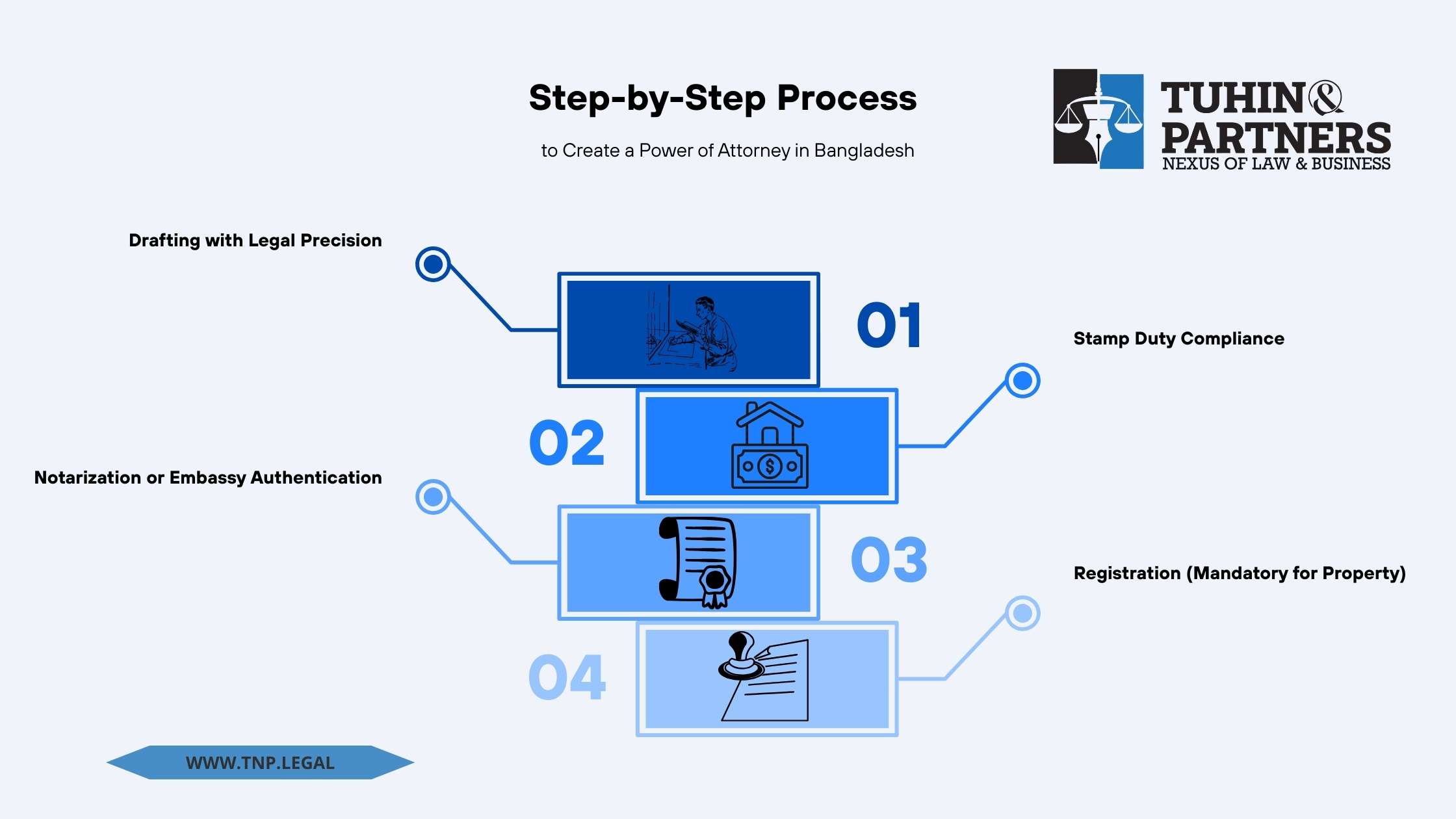 Step-by-step overview of drafting, stamping, notarization and registration required to create a Power of Attorney in Bangladesh.[/caption]
Step 1: Drafting with Legal Precision
The document must include:
-
Full names and identification (NID/passport)
-
Photographs
-
Detailed description of powers
-
Property details (if applicable)
-
Duration of authority
-
Revocation clause
-
Signature of principal
Ambiguity is the most common source of litigation. A vague sentence can cost years in court.
Step 2: Stamp Duty Compliance
Stamp Duty on Power of Attorney in Bangladesh
Stamp duty varies depending on whether the Power of Attorney is general, special, or irrevocable. The table below summarizes typical compliance categories. Exact duty may vary based on transaction value and property involvement.
Stamp duty depends on the nature of the POA.
[caption id="attachment_7242" align="aligncenter" width="1188"]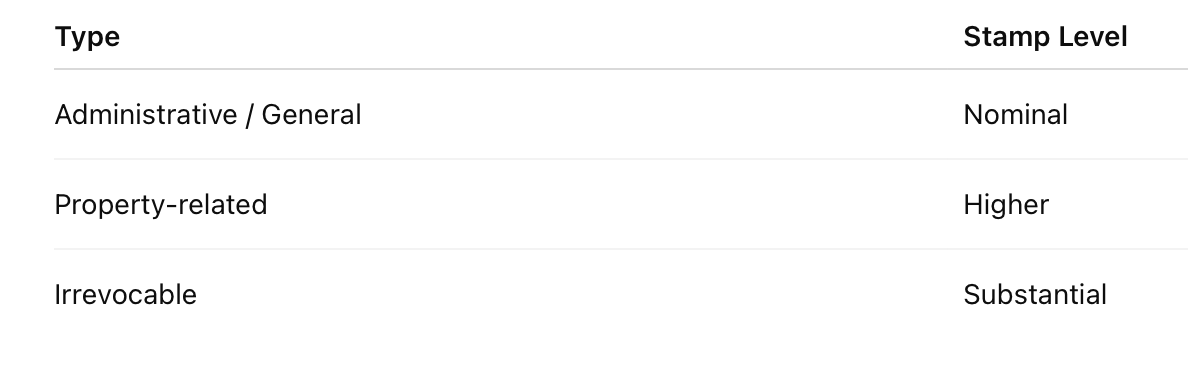 Stamp duty comparison for General, Special, and Irrevocable Power of Attorney in Bangladesh.[/caption]
Failure to pay the correct stamp duty may make the document inadmissible in evidence.
Compliance here is not optional.
Step 3: Notarization or Embassy Authentication
If executed inside Bangladesh:
The document must be notarized.
If executed abroad (common for NRBs):
-
Sign before the Bangladesh Embassy or Consulate
-
Authenticate the document
-
Send to Bangladesh
-
Obtain attestation from the Ministry of Foreign Affairs
-
Complete stamp duty within the statutory timeframe
Delay in stamping after arrival can invalidate its usability for property registration.
Procedural compliance is as important as drafting.
Step 4: Registration (Mandatory for Property)
If the POA involves immovable property, it must be registered at the Sub-Registrar's Office.
Without registration:
-
Land transfer will be rejected
-
Sale deed cannot proceed
-
Transaction becomes legally defective
Registration converts paper authority into enforceable authority.
Execution of Power of Attorney by NRBs
For Non-Resident Bangladeshis, a Power of Attorney is often essential. Managing property remotely without POA is nearly impossible.
The execution process abroad requires:
-
Embassy authentication
-
Official seal verification
-
Transmission to Bangladesh
-
MOFA attestation
-
Timely stamping
-
Registration if property-related
Many NRBs assume embassy authentication alone is enough. It is not. Domestic attestation and stamping complete the legal cycle.
Skipping a step creates future disputes.
Cost of Power of Attorney in Bangladesh (2026 Estimate)
Costs vary depending on complexity.
| Component | Estimated Range (BDT) |
|---|---|
| Drafting Fee | 10,000 – 30,000+ |
| Stamp Duty | Based on type |
| Registration Fee | Value dependent |
| Embassy Fee | Country specific |
Property-linked irrevocable POAs cost significantly more than administrative GPAs.
Cost should not be minimized at the expense of clarity.
Real-Life Risk Scenarios
Consider this common situation:
A father grants a General Power of Attorney to a relative to manage land. The GPA contains broad wording — including sale rights. Years later, the property is sold without full family awareness.
Litigation follows. The court examines the language. If the sale authority was clearly granted, reversal becomes difficult.
Another scenario:
An NRB signs a POA abroad but delays MOFA attestation beyond the prescribed time. When a property sale is attempted, the registration authority rejects the document.
Both examples demonstrate that mistakes are often procedural, not malicious.
Structure prevents damage.
Revocation of Power of Attorney
A POA may be revoked if:
-
The principal is mentally sound
-
Written revocation notice is issued
-
Revocation is registered (if original was registered)
For property-related POAs, revocation must also be registered.
Irrevocable POAs require stronger grounds — often judicial review.
Public notice publication is advisable to prevent misuse.
Automatic Termination of Power of Attorney
A POA automatically terminates upon:
-
Death of the principal
-
Completion of task
-
Expiry of specified duration
-
Loss of mental capacity
After death, the attorney’s authority ends immediately.
Transactions after death are void.
Is Power of Attorney Safe in Bangladesh?
Yes — when:
-
Properly drafted
-
Properly stamped
-
Properly registered
-
Narrowly defined
No — when:
-
Authority is vague
-
Registration is skipped
-
Monitoring is absent
-
Irrevocable clauses are misused
The law provides protection. But structure determines safety.
Comparison Table: Types of POA
| Feature | General POA | Special POA | Irrevocable POA |
|---|---|---|---|
| Scope | Broad | Specific | Usually specific |
| Risk Level | Higher | Lower | High if misused |
| Registration Required | If property-related | If property-related | Mandatory |
| Revocable | Yes | Yes | Difficult |
Can a Power of Attorney Transfer Ownership?
No.
Ownership transfers only through a registered deed under the Registration Act, 1908.
A POA authorizes execution of documents — it does not itself transfer title.
Confusion between authorization and ownership creates legal chaos.
Preventive Safeguards Before Granting POA
-
Limit scope
-
Avoid open-ended authority
-
Specify the property clearly
-
Include duration
-
Avoid unnecessary irrevocable clauses
-
Keep certified copies
-
Monitor transactions
Delegating authority does not mean abandoning oversight.
Conclusion
A Power of Attorney in Bangladesh is a powerful legal instrument designed to bridge absence and authority. It allows continuity, protects assets, and ensures compliance — especially for NRBs and property owners.
But its power demands discipline.
Law governs structure. Procedure governs validity. Precision governs protection.
Delegation without clarity invites dispute. Delegation with structure ensures stability.
FAQs: Power of Attorney in Bangladesh
1. What is a Power of Attorney in Bangladesh?
A legal document allowing one person to act on behalf of another under the Power of Attorney Act 2012.
2. Is registration mandatory for a Power of Attorney?
Yes, if it involves immovable property.
3. Can NRBs make a Power of Attorney from abroad?
Yes, through the Bangladesh Embassy authentication and the MOFA attestation.
4. What is the difference between GPA and SPA?
GPA grants broad authority; SPA grants limited authority.
5. How much does a Power of Attorney cost in Bangladesh?
It depends on drafting fee, stamp duty, registration, and embassy charges.
6. Can a Power of Attorney be revoked?
Yes, unless it is irrevocable and tied to consideration.
7. Does POA end after death?
Yes, it automatically terminates upon the principal’s death.
8. Is notarization enough without registration?
Not for property-related matters.
9. Can multiple attorneys be appointed?
Yes, jointly or separately.
10. What documents are required for registration?
NID/passport, photographs, draft deed, property details.
11. Can POA be challenged in court?
Yes, on grounds of fraud, coercion, misuse, or lack of capacity.
12. Is an irrevocable POA permanent?
Not necessarily. Courts may cancel if fraud is proven.
How Professional Legal Assistance Can Help
Although creating a Power of Attorney in Bangladesh may appear simple, mistakes in drafting, stamp duty compliance, or registration can create serious legal complications later—especially in property transactions or when the document is executed from abroad.
For Non-Resident Bangladeshis (NRBs), additional requirements such as embassy authentication, Ministry of Foreign Affairs attestation, and timely stamping in Bangladesh make the process even more sensitive. Errors at any stage may delay or invalidate the document.
Tuhin & Partners – Nexus of Law & Business assists clients with drafting, reviewing, registering, and revoking Power of Attorney documents in Bangladesh. The firm also supports NRBs with legally compliant POA execution for property management, legal representation, and business matters.
For professional assistance, contact:
📧 hello@tnp.legal
🌐 www.tnp.legal
Common questions
Does a power of attorney need to be registered in Bangladesh?
Powers of attorney relating to immovable property are required to be registered. Others may be valid without registration, but registration is often required in practice by banks and counterparties.
How is a power of attorney executed from abroad?
It is executed before and authenticated by the Bangladeshi embassy or high commission in that country, or otherwise legalised as required, and then stamped and registered in Bangladesh before it is used.
Can a power of attorney be revoked?
Yes, unless it is expressly irrevocable and coupled with an interest. Revocation should be formally recorded and notified, because a third party acting in good faith on an apparently subsisting power can create real difficulty.
Please note. This is general information about the law as it stood on 4 March 2026, not legal advice, and no solicitor–client relationship arises from reading it. Law and practice change; take advice on your own facts before acting.