
Legal Intelligence
NRB Land Purchase in Bangladesh – Complete 2026 Guide
In short
Non-resident Bangladeshis may buy land and property in Bangladesh, and the position differs from that of foreign nationals, whose direct ownership of land is restricted. The essentials are the same as for any Bangladeshi purchase — verify the chain of title and the record-of-rights entries, register the deed, and complete mutation into the buyer's name — with the added practical issue of executing documents from abroad.

NRB land purchase in Bangladesh is becoming a strategic priority for Non-Resident Bangladeshis (NRBs) who want to secure long-term assets in their home country. However, NRB land purchase in Bangladesh requires strict legal compliance, proper banking procedures, and structured due diligence to avoid financial and regulatory risks. At Tuhin & Partners, we provide end-to-end property advisory services tailored specifically for NRBs to ensure every land acquisition is secure, compliant, and investment-ready.
What Is NRB Land Purchase in Bangladesh?
NRB land purchase in Bangladesh refers to buying residential or commercial property by Non-Resident Bangladeshis. Agricultural land is restricted for NRBs unless inherited. Legal frameworks that govern this process include:
Why NRBs Should Invest in Bangladesh Property
Capital Appreciation – Urban expansion drives land value growth.
Rental Income – Secure steady passive income from leased properties.
Legacy Planning – Property for family, retirement, or inheritance.
Portfolio Diversification – Real estate adds stability beyond overseas investments.
Tuhin & Partners property advisory ensures your NRB investment is legally protected and structured for maximum returns.
Step-by-Step Process for NRB Land Purchase in Bangladesh
rn[caption id="attachment_7208" align="aligncenter" width="1920"]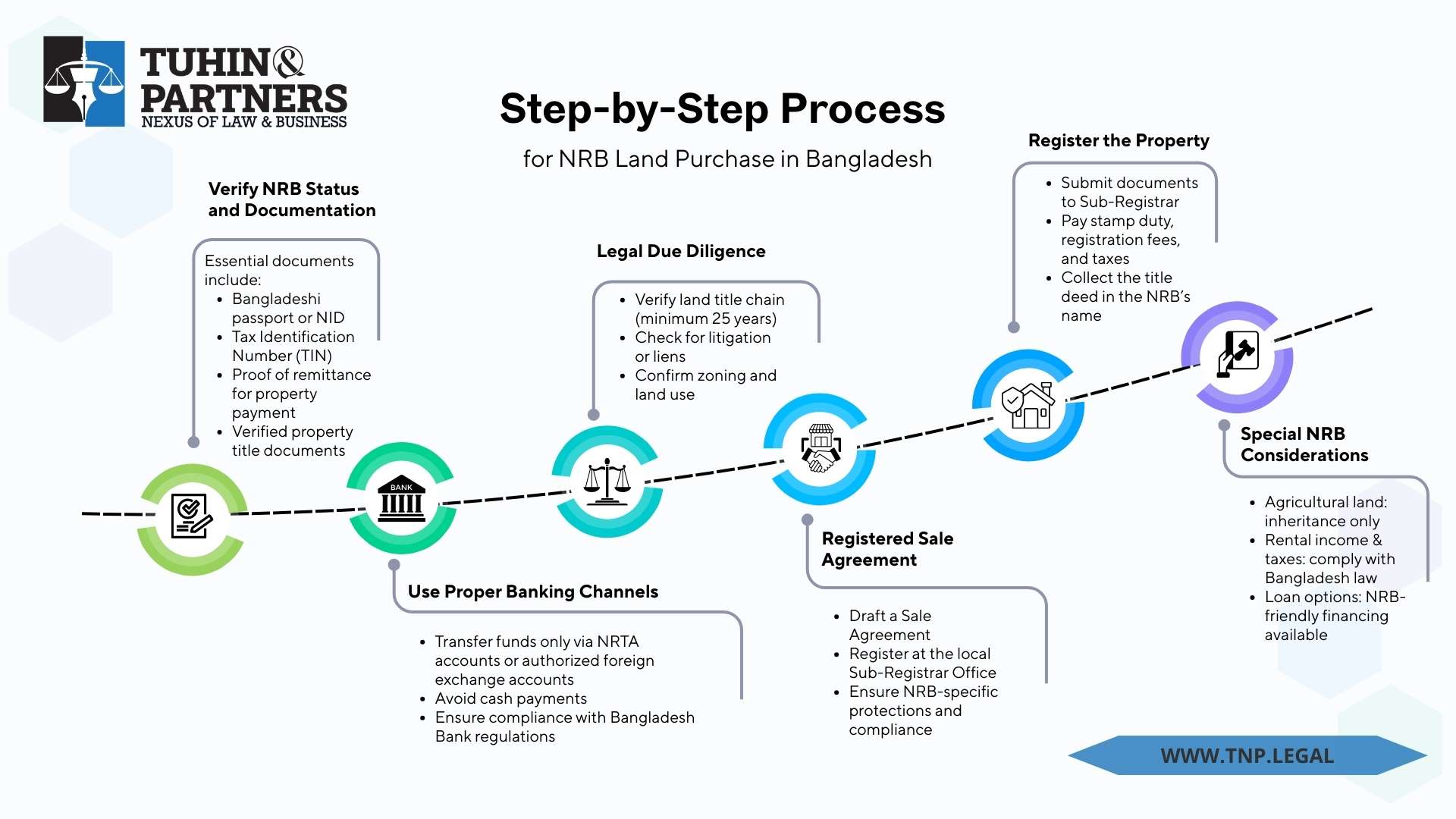 Step-by-Step Process for NRB Land Purchase in Bangladesh[/caption]rn
Step 1 – Verify NRB Status and Documentation
Essential documents include:
Proof of remittance for property payment
Verified property title documents
Step 2 – Use Proper Banking Channels
Transfer funds only via NRTA accounts or authorized foreign exchange accounts
Avoid cash payments
Ensure compliance with Bangladesh Bank regulations
Step 3 – Legal Due Diligence
Verify land title chain (minimum 25 years)
Check for litigation or liens
Confirm zoning and land use
Tuhin & Partners conducts full legal due diligence to protect NRBs.
Step 4 – Registered Sale Agreement
Draft a Sale Agreement
Register at the local Sub-Registrar Office
Ensure NRB-specific protections and compliance
Step 5 – Register the Property
Submit documents to Sub-Registrar
Pay stamp duty, registration fees, and taxes
Collect the title deed in the NRB’s name
Step 6 – Special NRB Considerations
Agricultural land: inheritance only
Rental income & taxes: comply with Bangladesh law
Loan options: NRB-friendly financing available
Common Mistakes NRBs Should Avoid
Paying in cash
Skipping title verification
Using improper banking channels
Ignoring tax or mutation requirements
Tuhin & Partners property advisory helps NRBs avoid these risks.
Why Choose Tuhin & Partners?
Integrated Legal, Tax & Compliance Advisory
Led by Osman Gani Tuhin – expert in NRB property & corporate compliance
End-to-End Due Diligence – title verification, risk analysis, mutation support
NRB-Centric Services – banking compliance, inheritance structuring
Risk Prevention & Investment Security – avoid disputes & fraud
Strategic Long-Term Planning – property investment optimized for growth
Strong Ethical Standards & Transparency
Property disputes in Bangladesh often stem from:
Informal payments
Poor documentation
Unverified brokers
Missing tax records
Tuhin & Partners maintains:
Transparent fee structures
Documented compliance trails
Proper banking channel guidance
Structured advisory process
The firm does not rely on shortcuts—it builds defensible legal positions.
Strategic Vision Beyond Property
Tuhin & Partners is not just a property law firm. It positions itself as Bangladesh’s emerging legal and compliance infrastructure platform, advising clients in:
Corporate law
Investment structuring
Tax advisory
Regulatory risk
Commercial contracts
For NRBs who plan to invest further in Bangladesh—whether in real estate, business, or joint ventures—the relationship becomes long-term, not transactional.
FAQs – NRB Land Purchase in Bangladesh
Q1: Can NRBs legally buy land in Bangladesh?
A1: Yes, NRBs can buy residential and commercial land. Agricultural land is restricted unless inherited.
Q2: What documents do NRBs need?
A2: Passport/NID, TIN, proof of remittance, and verified property documents.
Q3: How should NRBs transfer money?
A3: Through NRTA accounts or authorized foreign exchange accounts. Avoid cash.
Q4: Do NRBs need to register the property?
A4: Yes, registration at the Sub-Registrar Office is mandatory.
Q5: Can NRBs get loans to buy property?
A5: Yes, many banks provide NRB-specific loans with equity requirements.
Q6: Why hire Tuhin & Partners?
A6: End-to-end legal, tax, and compliance advisory tailored for NRBs.
Q7: What mistakes should NRBs avoid?
A7: Paying in cash, skipping title verification, ignoring taxes, and using improper banking channels.
Common questions
Can a non-resident Bangladeshi buy land in Bangladesh?
Yes. Non-resident Bangladeshis may acquire property, and payment brought in through the banking channel also assists if funds are later to be taken out.
Can property be purchased from abroad without travelling?
It can be done through a power of attorney executed abroad and properly attested and, where required, registered in Bangladesh. The scope of the power should be drafted carefully, because an attorney acting outside it can create a defective transaction.
What is the most common mistake in a Bangladeshi land purchase?
Relying on the seller's deed alone. Title has to be traced through the chain of documents and the record-of-rights, checked for encumbrances and litigation, and completed with mutation after registration.
Please note. This is general information about the law as it stood on 1 March 2026, not legal advice, and no solicitor–client relationship arises from reading it. Law and practice change; take advice on your own facts before acting.