Introduction to the BSTI License in Bangladesh
Let’s be honest—no one wants to buy a product they don’t trust. Whether it’s food, electronics, cement, or cosmetics, quality and safety are non-negotiable. That’s exactly where the BSTI License in Bangladesh steps in like a quality gatekeeper.
BSTI, short for Bangladesh Standards and Testing Institution, is the national authority responsible for setting standards, testing products, and issuing certification marks. If you are a manufacturer, importer, or distributor dealing with regulated products, a BSTI license in Bangladesh is not optional—it’s the law.
This updated 2026 guide breaks down everything you need to know in plain English, without legal jargon overload. Think of it as your roadmap from confusion to compliance.
Why the BSTI License in Bangladesh Is So Important
Imagine driving a car without brakes. That’s what selling regulated products without BSTI approval feels like—risky and illegal.
A BSTI license ensures:
-
Product quality and safety
-
Consumer trust and brand credibility
-
Legal protection from fines and penalties
-
Smooth customs clearance for imports
-
Eligibility for government and corporate tenders
In short, BSTI certification isn’t just a stamp—it’s your business insurance policy.
Authority and Organisational Structure of the BSTI License in Bangladesh
BSTI operates under the Ministry of Industries and has a strong nationwide presence to ensure effective monitoring and enforcement.
BSTI Head Office Details
-
Address: Maan Bhaban, 116/A, Tejgaon Industrial Area, Dhaka-1208
-
Phone: 55030054, 55030063, 55030069, 55030080
-
Fax: (880-2)-9131581
-
Email: dg@bsti.gov.bd
-
Website: www.bsti.gov.bd
Legal Framework Governing the BSTI License in Bangladesh
Understanding the law behind BSTI is like knowing the rules of the game before playing.
Pre-BSTI Institutions
Before BSTI existed, quality control functions were handled by:
-
Central Testing Laboratories (CTL) – established in 1955
-
Pakistan Standards Institution – Dhaka office in 1957
Establishment and Evolution of BSTI
After independence, the Bangladesh Standards Institution (BDSI) was formed. In 1985, BSTI was officially created by merging BDSI and CTL, creating a unified national standards body.
Later, in 1995, the Department of Agricultural Grading and Marking was merged into BSTI.
Current Governing Laws
Two key laws now govern BSTI operations:
These laws strengthened enforcement powers, penalties, and compliance mechanisms.
What Is a BSTI License?
A BSTI License, also known as a Certification Mark (CM) License, is official approval confirming that a product complies with relevant Bangladesh Standards (BDS).
It guarantees:
-
Standardized production
-
Ongoing factory inspection
-
Periodic product testing
Selling mandatory products without this license is a criminal offense under Bangladeshi law.
Products Covered Under the BSTI License in Bangladesh
More than 300 products currently require mandatory BSTI certification, including:
-
Food and beverages
-
Electrical and electronic items
-
Cement and construction materials
-
Chemicals and fertilizers
-
Cosmetics and toiletries
-
Weighing and measuring devices
The list is updated periodically, so checking before production or import is critical.
Types of BSTI Certification
Mandatory Certification (CM License)
This is legally required for listed products before manufacturing, importing, or selling. It’s the most common BSTI license type.
Voluntary Certification
Not legally required, but businesses use it to enhance credibility and gain a competitive edge.
Certification for Imported Products
Importers must obtain a BSTI Clearance Certificate (Certificate of Conformity) to release goods from customs.
Management System Certification (MSC)
BSTI also certifies ISO standards such as ISO 9001, ISO 14001, and ISO 22000. This is separate from product certification.
Type A and Type B License Explanation
-
Type A: Products involving raw materials and chemicals (e.g., paints, detergents)
-
Type B: Processed food, cosmetics, textiles, and similar goods
Step-by-Step Process to Obtain BSTI License in Bangladesh
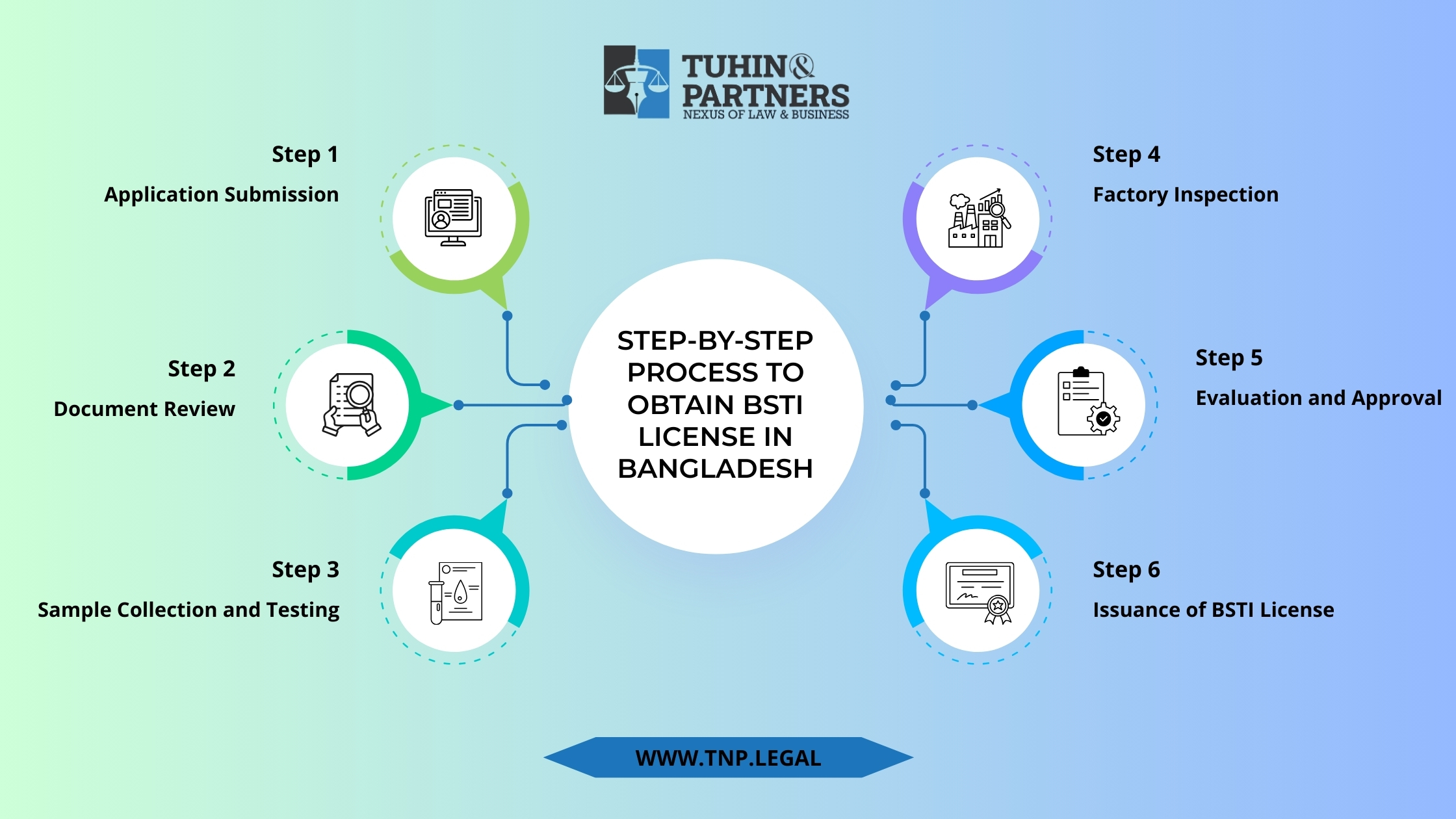
Step 1: Application Submission
Submit Form-1 along with:
-
TIN and VAT Certificate
-
Factory layout and ownership documents
-
Product label (Bangla mandatory)
-
Process flowchart and composition
-
Product samples
Step 2: Document Review
BSTI checks authenticity, product scope, and legal compliance. Incomplete files cause delays—attention to detail matters.
Step 3: Sample Collection and Testing
BSTI collects samples and tests them in approved labs against BDS standards. Failed tests mean reapplication after correction.
Step 4: Factory Inspection
Inspectors evaluate machinery, production process, quality control, and storage conditions.
Step 5: Evaluation and Approval
The Licensing Committee reviews inspection and test reports. Approval depends on full compliance.
Step 6: Issuance of BSTI License in Bangladesh
Once approved, the CM License is issued with a unique number, valid for three years.
Processing time usually ranges from 19 to 42 working days.
BSTI E-Application System
BSTI now offers online applications through:
👉 https://bstieapp.gov.bd/
Key Services Available Online
-
New CM License application
-
License renewal
-
Brand inclusion
-
Halal certification
-
Import clearance certificates
The portal improves transparency, reduces paperwork, and speeds up processing.
BSTI License in Bangladesh (Fees and Costs)
|
|---|
Fees may change based on BSTI circulars.
Validity and Renewal of BSTI License in Bangladesh
-
Validity: 3 years
-
Renewal: Apply 3 months before expiry
-
Late renewal may cause suspension or cancellation
Penalties for Non-Compliance
Operating without a valid BSTI license can result in:
-
Fine up to BDT 200,000
-
Imprisonment up to 2 years
-
Seizure of goods
-
Business blacklisting
BSTI regularly conducts market surveillance, so compliance is not optional.
Benefits of Obtaining a BSTI License in Bangladesh
-
Legal protection
-
Increased consumer trust
-
Higher sales potential
-
Export eligibility
-
Improved product consistency
-
Access to government tenders
Practical Tips for Faster BSTI Approval
-
Use professional consultants
-
Maintain proper quality control systems
-
Ensure Bangla labeling compliance
-
Keep documents updated
-
Follow up regularly with BSTI offices
Conclusion
The BSTI License in Bangladesh is more than a regulatory checkbox—it’s a business asset. It protects consumers, strengthens brands, and ensures long-term market access. With the right preparation, accurate documentation, and compliance mindset, obtaining a BSTI license in 2026 can be smooth and hassle-free.
If you want speed, accuracy, and peace of mind, professional guidance can make all the difference.
FAQs on BSTI License in Bangladesh
1. Is the BSTI license mandatory for all products?
No, only products listed under mandatory certification require it.
2. How long does it take to get a BSTI license?
Usually 19–42 working days, depending on product and documentation.
3. Can importers apply for a BSTI license?
Yes, importers must obtain BSTI clearance certificates for regulated items.
4. What happens if my product fails BSTI testing?
You must correct the issue and reapply for testing.
5. Is the BSTI license renewable?
Yes, it must be renewed every three years.
Editor: Osman Gani Tuhin
Author: Anisa Tahsin
Tuhin & Partners is a Dhaka‑based law firm providing professional legal and compliance support for businesses searching for BSTI License services near BSTI consultants in Dhaka. We assist importers, manufacturers, and distributors in Dhaka and surrounding business hubs with BSTI eligibility assessment, compliant document preparation, application submission, product testing coordination, and direct liaison with BSTI offices located in Dhaka.
Our team regularly works with clients looking for a BSTI License near Dhaka, BSTI approval service in Dhaka, and BSTI legal consultants close to me, ensuring faster processing, reduced compliance risks, and smooth regulatory approvals under Bangladesh law.